Learning Microeconomics · Introduction
What is economics?
Scarcity, choice, and the production possibility frontier
People often hold a mistaken belief about economics, thinking it has something to do with money, finance, or the stock market. While some economists do study all those things, that is not what economics really is about. In fact, economics begins with a simple fact – resources are limited (or scarce), and people face trade-offs and make choices. It is this making of choices under constraint is what economics is all about. Education is one of those places to see them quite simply. After all, almost everyone universally has been part of education in one form or the other.
Economics begins with choice
We see these choices in the decisions students make, the incentives school districts and higher education institutions face and the constraints under which all of this is made. Think about the decision that students face. Should a high school student start working full-time after graduation or go to a 4-year college? Or maybe a community college while working part-time? What about a vocational school? And which major? Or whether a university should build a new lab building, more dorms, or a football stadium. Should a high school spend money renovating the gym or fund school trips to an out-of-state national park?
These choices, these trade-offs, and why they are made is what economics is actually about. In fact, the path not taken has its own special place in economics, and its own name. Opportunity cost.
Thus economics is not just the study of money. No, it is the study of choice under constraint. It is how individuals and firms (and this includes schools and colleges) make decisions when resources are limited and when choosing one path means giving up another.
Scarcity does not imply that there is a shortage. Rather it means that resources have alternative uses, and that choosing one way of using it means giving up another use of it.
If you are using a classroom to teach French to a group of high school students, you cannot use the same room to teach Spanish. Conversely, Amy, a sophomore college student can enroll in five classes in the Spring semester but the Silver State University offers three hundred classes. Similarly, a university has only so much land, funds, and labor, and even the wealthiest institutions cannot build a hundred new dorms and a hundred academic buildings at the same time.
Opportunity cost: the cost in terms of what is given up
Now that we understand that resources are limited, it becomes clear that there will be tradeoffs, things that are given up in terms of the road not taken. And that is considered an implicit cost. Economists call this opportunity cost: the value of the best alternative given up when a choice is made.
Let’s consider an example. For a university student, the cost of college is not only tuition, fees, books, and housing expenses. It also includes the income that student could have earned by going straight into the labor force after high school if they had gotten a full-time job. Those forgone wages are not any explicit payments being made by anyone, but they are a cost incurred as a consequence of making the choice to enroll at an university. They are part of the opportunity cost of choosing college over work.
The same logic applies at the institutional level. If a university says a new football stadium costs two hundred million dollars, that is the accounting cost, the actual payments being made. But the economic question is what else those same two hundred million dollars could have produced. Could the university have built new dormitories? Updated classrooms? Better labs? More financial aid? The true economic cost of the stadium is the value of the best alternative not chosen.
This is what economists mean when they say there is no such thing as a free lunch. Or the phrase you can’t have your cake and eat it too. Every yes implies a no. Every new stadium built means a lab or classrooms that were not built. Every choice involves an opportunity cost.
Thinking at the margin
Economists also like to think that people make decisions in a particular way. They say that agents (people and firms) think at the margin. That means deciding whether doing a little more or a little less of something is worth it. Now, to be clear, this does not meant that people are choosing actively to pursue “marginal thinking” and behave this way. Rather, economists think marginal thinking is a simple and useful way to model how people and firms behave. Let’s explore this more with a couple of examples.
A student does not usually decide whether a college degree and major is worthwhile without considering the options. They consider the costs (monetary and effort of going to classes) against the benefits. This can be on a Monday morning for an 8AM class, and some students may choose to get an extra hour of sleep. Or it could be deciding on one more semester to get a double major, or one more year of graduate school, and the better job prospects or higher wages being worth the additional cost. Similarly, a Dean (an administrator at a university or college) does not decide whether to hire more faculty simply because smaller classes and more individualized teaching should lead to better outcomes. Rather they decide if one more faculty hired in Psychology, or one more lab built for the Physics department is worth the costs being incurred and whether it could be more useful elsewhere.
So how does marginal thinking work? Well it’s something like this: Marginal thinking is an economic agent (a person or a college) asks whether the marginal benefit of one more unit of something (going to class, building a new lab) exceeds the marginal cost of that extra unit. This way of thinking underlies almost every decision we make – whether it’s the personal choice of waking up and going to an 8AM class (you definitely should!), or new physics labs being built, or even public policy decisions such as opening new schools or closing them. But then why do people make different decisions given the same choices? Well, it’s because they value things differently and may face different costs (implicit and explicit). Someone who is a night owl will assign a higher cost of waking up early to attend a 8AM class compared to a morning person, and might be less focused and have lower learning outcomes than the latter. Thus two people with the same choices of sleep vs 8AM class having different marginal benefits and costs and possibly making different decisions.
The Production Possibilities Frontier
One way to visualize opportunity costs, and they do become easier to see, is when they are given a shape. Economists use the Production Possibilities Frontier, or PPF, to do exactly that.
The PPF is a graph that shows the combinations of two outputs an economy or institution or even a single person can produce given its current resources and technology. It is deliberately simple, and we use two things to make the visualization easy to replicate on paper. Any economic agent, let alone institutions and economies, probably produces many things. But reducing the choice to two broad outputs makes the opportunity cost, the trade-off in terms of the best alternative, much easier to see.
Now, instead of going into a discussion of if it is a good decision or not (we will discuss that later), imagine a university choosing between two priorities: Academics and Athletics. Academics includes classrooms, laboratories, libraries, more teachers and faculty, and other core academic infrastructure. Athletics includes a new stadium and related athletic spending. If those two outputs are placed on a graph, the PPF shows the combinations of academics and athletics the university can realistically achieve with the budget it currently has.
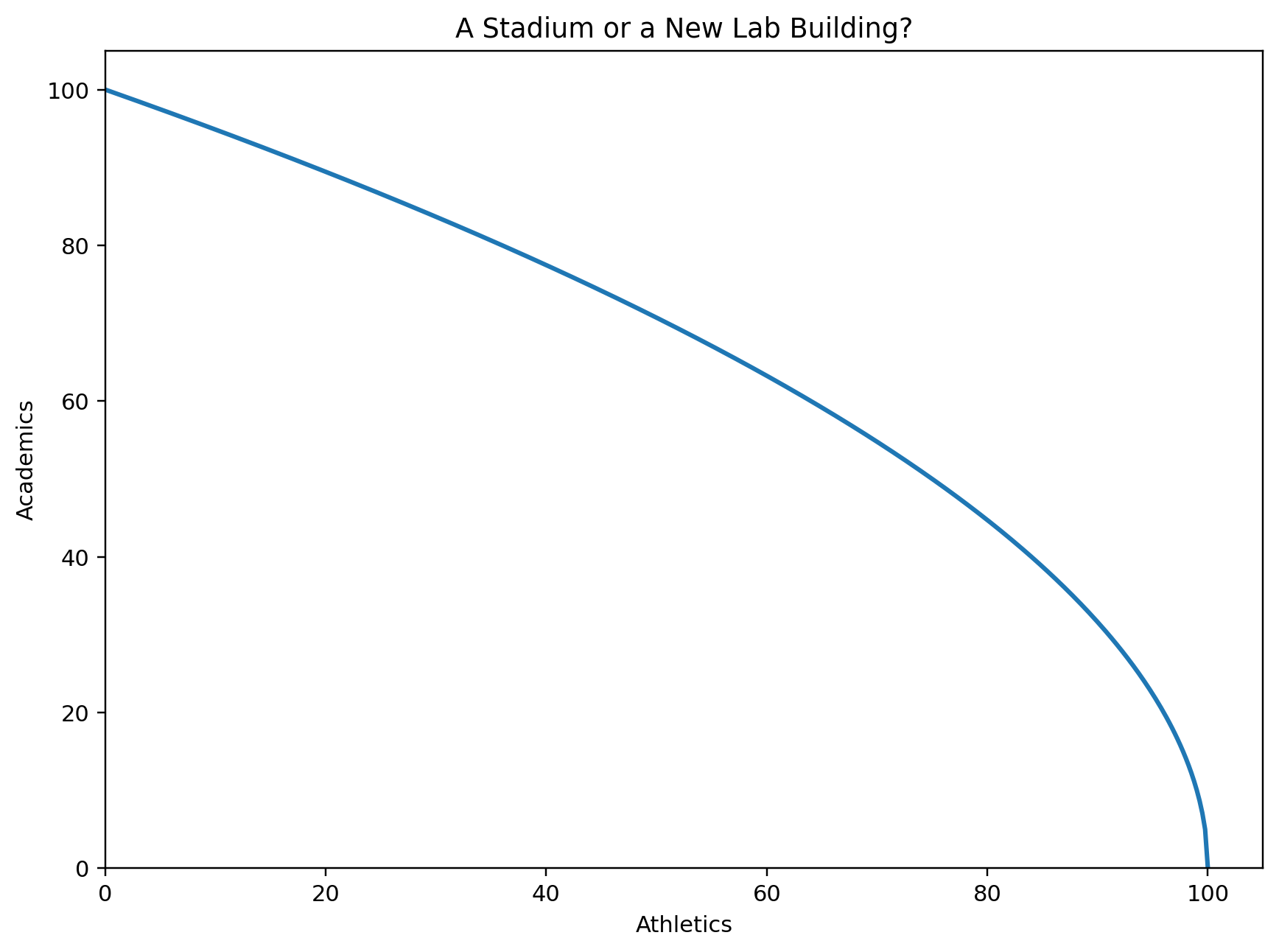
Every point on the PPF frontier is a feasible combination. If the university wants more athletics, it must give up some academics. If it wants more academics, it must give up some athletics. Points on the frontier are feasible and efficient: the institution is making full use of its resources and nothing is being wasted. Points inside the frontier are feasible but inefficient, meaning the university could produce more of both if it used what it already had more effectively. Points outside the frontier are unattainable under current conditions (resources and technology). Wanting more does not make more possible.
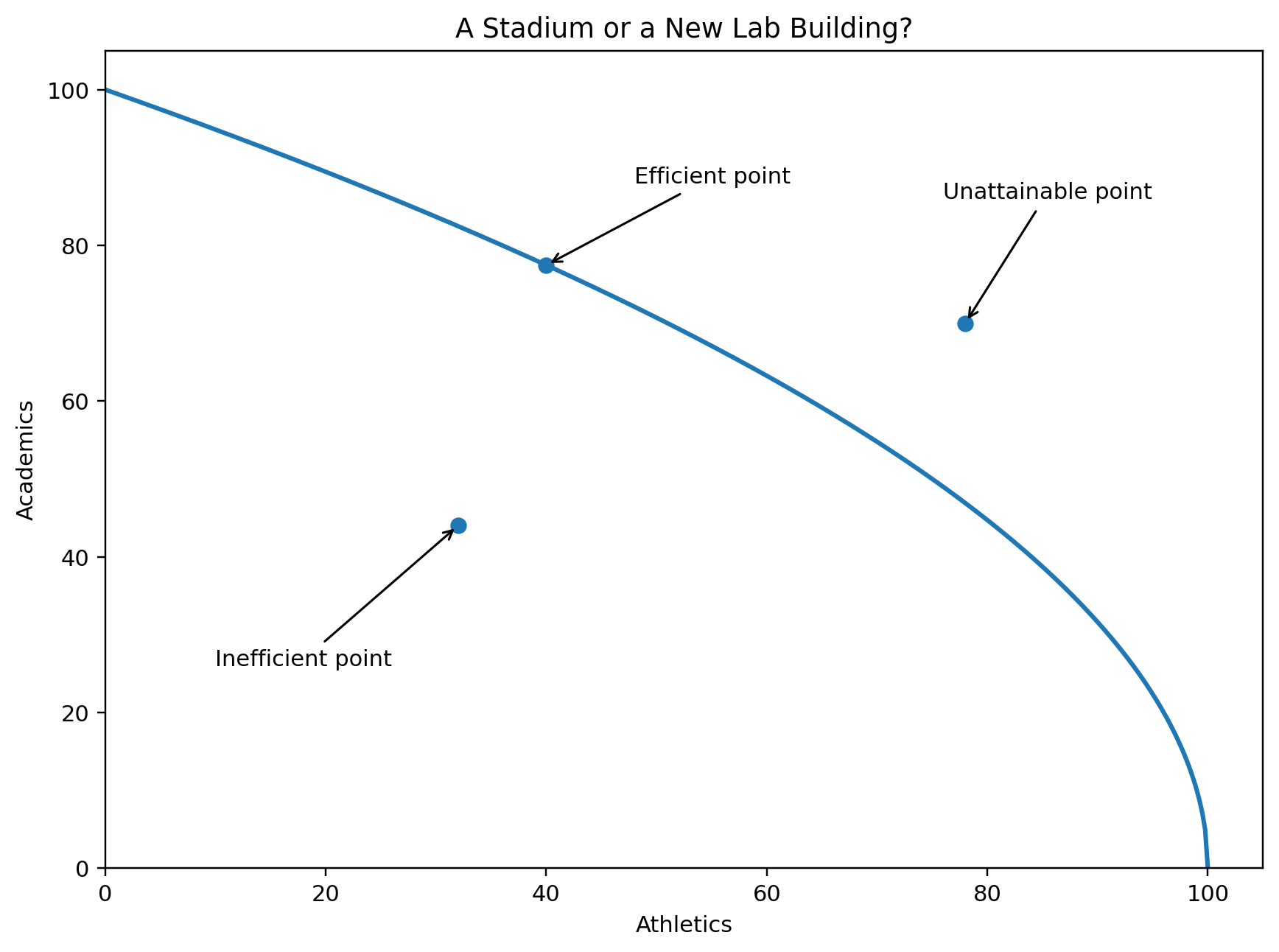
In the real world, this frontier is usually bowed outward. That reflects increasing opportunity cost. Resources are specialized. The first reallocation from academics to athletics may be manageable. But as a university pushes further towards more athletics, building a larger stadium, or new training grounds and more athletics staff, it eventually begins to sacrifice more and more academics. This could be land that’s great for a marine lab, but not necessarily good for building a stadium. Or a dean and administrator who is great at running a college, but not great at managing a whole athletics department. The trade-off, this opportunity cost becomes steeper. That is why the curve bends.
The Production Possibilities Frontier is a great visualization of the problem of diminishing returns – not all resources are equally well-suited to one thing. A basketball coach is not going to be as good at teaching history, and a physics teacher might not be a great swim coach.
The same logic can be applied elsewhere in education too. A school district may face a trade-off between building elementary schools or spending more on high school vocational and trade programs. The state and federal government may face a trade-off between funding elite research universities and expanding broad-based free community colleges. The scenarios and opportunity costs may be different, but the essence remains the same – more of one thing implies less of another.
Growth and a shifting frontier
The PPF itself is not fixed forever. It can shift outward if an institution gains more resources or becomes more productive. Hiring more teachers, building more classrooms, generous alumni funding can expand what a school or institution is capable of producing. So can better technology, better organization, or improved teaching methods.
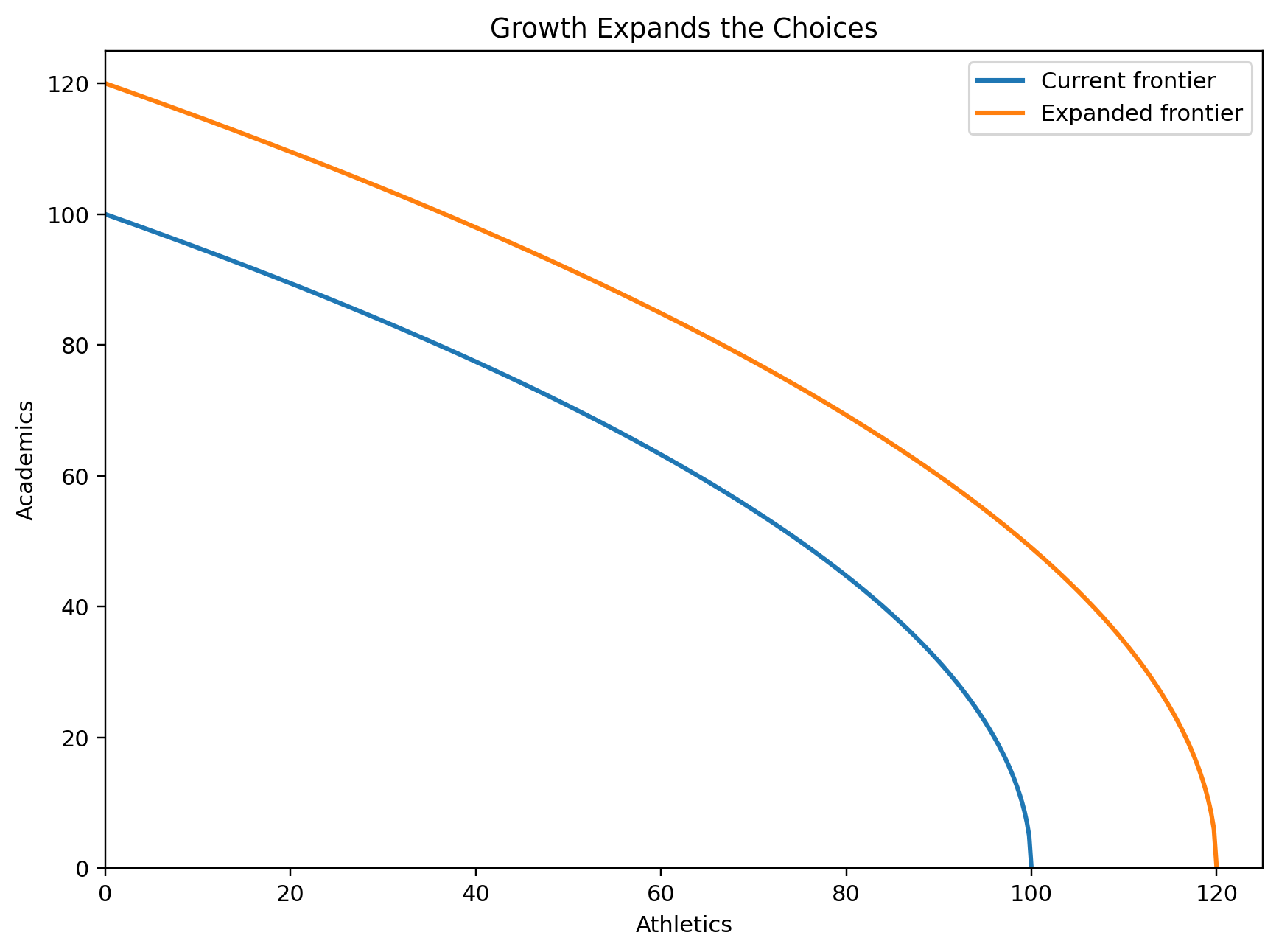
This matters because economics is not just about constraints. It is also about how these constraints can change. Scarcity of resources will always hold, but it is not necessarily fixed at the same level all the time. Institutions can innovate, invest, and expand what becomes possible over time.
What economics can do — and what it cannot
Economics studies trade-offs and opportunity costs. It tells us the real costs of a decision, not just the monetary value. In our above example, it tells us that shifting investment away from labs to athletics leaves less for academics, so fewer classrooms, teachers or labs. It can show that some goals are unattainable without more resources. It can help distinguish inefficiency from genuine constraint.
But economics does not, by itself, tell us what we ought to value most. That is where normative judgment enters. The goals of an institution (or an individual, or even the society) is not the same and is not universal. A university may be ‘efficient’, that is producing at a point on the PPF. But if it is focusing too much on athletics and not on academics, it maybe pursuing priorities that most people misguided. But this is a value judgement. In economics we call this is a normative statement. Positive statements are objective, they are statements of facts and data. They are testable. (“what is”). An example would be “Silver State University spends more on athletics than on academics.” It may be true or false, but it is something we can test and confirm to be true or false. However, normative statements are subjective, value-based judgments (“what should be”). For example, “Institutions should spend 80% of their budget on academics.” Where positive statements can be proven true or false, normative statements reflect opinions, ethics, or goals of individuals or of society. They are not universal truths, but may reflect individual preferences and norms.
Microeconomics, not macroeconomics
This series is about microeconomics, not macroeconomics. Macroeconomics studies the economy as a whole. This means inflation, unemployment, recessions, growth, international trade. All those things that you hear in the news. And they are important concepts, but will need to be discussed at another time. Just know that economics as a subject started with macroeconomics, the big picture, before economists realized that to truly understand the big picture, you had to start from the things that build up the whole economy, the individual consumers(individuals) and firms(businesses). That is what Microeconomics is. It is the study of individual agents making decisions: students, families, firms, schools, universities, and the markets in which they interact.
That distinction matters because it is important you understand what you will be reading here for the next 15 chapters won’t explain why the a country’s economy is growing, or why there is inflation, or even how to measure it. The questions we will be discussing is why students make the choices they do, why institutions behave the way they do, and how the education markets function.
What you have learned so far
Scarcity means resources are limited, and thus have alternative uses, so choices must be made.
Opportunity cost is the value of the best alternative not chosen.
The PPF visualizes these choices and tradeoffs, and helps identify what is efficient, inefficient, and what growth looks like.
In the next chapter, we will talk about one of the most fundamental concepts in economics – demand. What determines how many students want to attend college, and how that changes when tuition rises, incomes fall, or demographics shift. Once scarcity, opportunity costs, and constraints are in place, the rest of microeconomics becomes much easier to understand.